How India Became the World’s Most Complex Live Event Market for Weddings
Where rituals meet rock concerts, logistics fight astrology, and “one night” lasts five days.
5/8/20242 min read
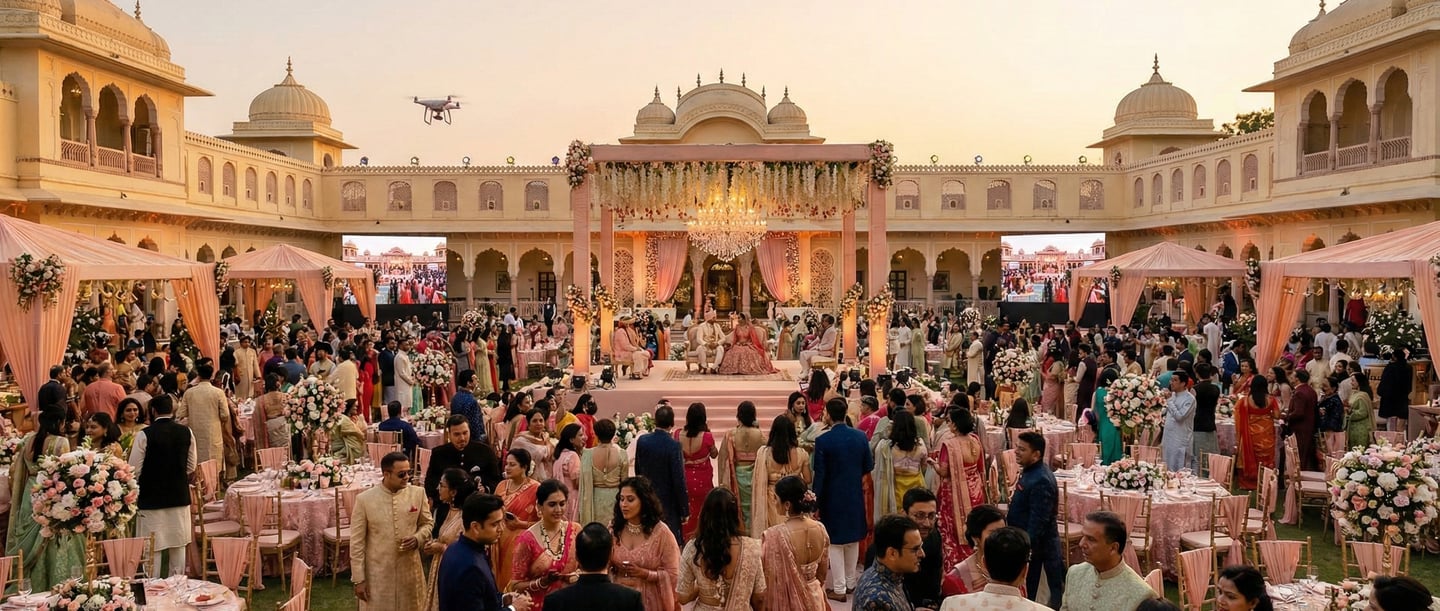
Epic festival vibes
In most countries, a wedding is an event.
In India, a wedding is a temporary universe.
It begins before the guests arrive and lingers long after the music stops. It spills from homes into streets, from temples into ballrooms, from tradition into technology. Somewhere between a sacred fire and a laser-lit stage, India quietly built the most complex live wedding event market on Earth. Not by design. By culture.
A Wedding That Refuses to Be One Thing
An Indian wedding is not a single production. It is a chain reaction.
There is the engagement that feels like a formal announcement. The mehendi that becomes a daytime celebration. The sangeet that morphs into a full-scale music show. The wedding ceremony governed by astrology. The reception that looks suspiciously like a celebrity concert.
Each function has a different emotional objective.
Each demands a different production language.
Each hosts a different mix of guests.
Globally, weddings are streamlined. In India, they expand.
This expansion is the first reason India’s wedding live event industry defies simple categorization.
When Culture Becomes the Creative Brief
In most live events, culture inspires design.
In Indian weddings, culture dictates it.
Timelines are not decided by production managers alone. They bow to muhurats—astrologically auspicious timings that cannot be negotiated, only respected. Rituals cannot be shortened because “the artist is waiting.” Ceremonies cannot be moved indoors because it might rain.
Add to this the regional diversity.
A North Indian wedding and a South Indian wedding might share the word “wedding” and little else. Customs change across states, cities, and sometimes families. Event planners and artist managers aren’t just coordinating logistics; they are translating belief systems into executable production plans.
This is live event management where heritage outranks efficiency.
Venues That Aren’t Just Venues
In India, venues rarely come “ready.”
Palaces must be adapted to modern production. Beach resorts need temporary infrastructure. Five-star hotels are transformed beyond recognition. Open grounds become pop-up cities complete with power, backstage areas, and control rooms.
Every wedding becomes a site-specific production.
The venue isn’t a backdrop. It’s a challenge to be solved.
The Invisible Workforce Behind the Celebration
For every moment that looks effortless, there is an army working in silence.
Event planners coordinate hundreds of vendors. Artist management teams align performances with rituals. Technical crews operate on minimal rehearsal time. Family representatives oversee emotional correctness. Cultural advisors ensure nothing crosses an invisible line.
This ecosystem works under immense pressure because failure isn’t just professional—it’s personal.
In Indian weddings, reputations, relationships, and legacies are at stake.
Weddings as India’s Quiet Entertainment Industry
Behind the glitter lies an economic powerhouse.
Indian weddings employ thousands of artists, technicians, designers, choreographers, sound engineers, planners, and agencies year-round. They rival large-scale concerts in budget and complexity, yet operate without the formal recognition of the entertainment industry.
In many ways, weddings are India’s most consistent live event sector—immune to trends, resilient to downturns, and powered by cultural inevitability.
Conclusion
India didn’t make weddings bigger. It made them deeper.
By layering ritual, scale, emotion, and live entertainment into a single experience, India created the most complex wedding event market in the world. This isn’t chaos—it’s culture in motion. Every wedding becomes a one-time production where tradition sets the rules and creativity finds a way.
You don’t simplify Indian weddings.
You learn to orchestrate them.
And that’s what makes this market impossible to copy—and unforgettable to witness.